


Brand identity tends to be discussed in terms of logos, websites and advertising budgets.
Yet some of the most persuasive brand moments happen well away from a screen. A courier arriving at a client’s door, a barista handing over a coffee, a receptionist greeting a visitor: each one is a small piece of marketing, and what that person is wearing shapes how it lands.
In a city as crowded as London, where businesses compete for attention on every street, looking coherent is a genuine advantage. It doesn’t take a formal uniform to achieve it, and for many firms a formal uniform would feel wrong anyway.
Why does what your team wears matter?

Customers rarely separate the person from the company. If three members of staff turn up to an event in mismatched clothes, the unspoken message is that the details haven’t been thought through. If they arrive in the same colours with the same simple logo, the message is the opposite, and nobody has to say a word. That’s why more founders now treat staff wear as part of the brand toolkit, alongside signage, packaging and the website.
There’s a practical side too. At exhibitions, site visits and client meetings, identifiable staff are easier to find, which saves time and avoids the awkward “are you with the company?” conversation. For businesses with several departments or locations, it also gives people who rarely meet a visible sense of being on the same side.
The practical question for most small and medium-sized firms is how to do it without overspending. Buying wholesale hoodies in a single order is a common answer. It gives every employee the same garment at a lower cost per piece than ordering one at a time, and it keeps colours and sizing consistent across the whole team, which is surprisingly hard to manage when people order for themselves.
How should you choose colours and logo placement?
Start with what you already have. Your bran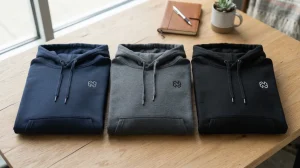 d palette probably includes one or two core colours, so the easiest route is to pick a garment colour that sits close to them. Black, navy and grey are forgiving and suit almost any logo, while a single brighter shade can help a team stand out at trade shows and networking events.
Keep the decoration restrained. A small, embroidered mark on the chest looks more considered than an oversized print, and it ages better. Think about whether the logo needs to work on a hood, a sleeve or a back panel, and check the artwork on a sample before committing. Mistakes are far cheaper to fix at the proofing stage than after several dozen garments have been decorated.
What does a sensible ordering process look like?
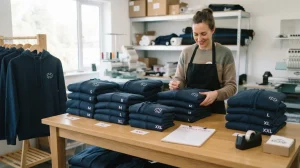
Begin by counting heads honestly, including part-timers, contractors and anyone you expect to hire in the next six months. Order a few spares across a spread of sizes so that a new starter isn’t left waiting. Ask your supplier about reorders too, because colours can vary slightly between production runs and you’ll want new stock to match the old.
It also pays to decide who’s in charge. One named person handling sizes, proofs and deliveries avoids the group email chain where nobody’s quite sure what was agreed. Build in plenty of lead time, particularly before Christmas, when printers and embroiderers are at their busiest.
Can staff wear help with recruitment and retention?
In a modest way, yes. Being handed a well-made garment on your first day signals that the business planned for your arrival. Managers in hospitality, retail and creative agencies often say that small touches like this shape a new starter’s first impressions more than they’d expect. People also tend to wear good kit outside work, which turns employees into credible advocates for the brand without anyone having to ask them.
Where does sustainability fit in?
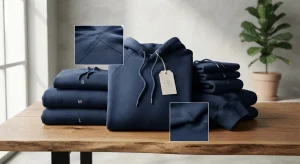
Increasingly, clients and customers ask about it. The sensible position for a small business is simply to avoid waste: choose garments that will survive years of washing, order what you need rather than what looks impressive on a spreadsheet and think about what happens to surplus stock. A hoodie worn for five winters is a better story than three replaced after one.
There’s a financial side to this as well. Replacing worn-out clothing every season quietly erodes the savings you made by buying in bulk, so durability is worth testing before you place the main order. Wash a sample a dozen times and see how the cuffs, hood and print hold up.
What’s the takeaway?
Branding isn’t only for the marketing department. It lives in the small details that customers notice without quite realising it, and staff wear is one of the most visible of them. Get the colour, fit and decoration right, keep it simple, and your team will do a good share of the brand-building for you.
The London businesses that manage this well tend to share one habit: they treat it as a piece of planning rather than an afterthought. A little attention at the start saves money, avoids awkward conversations later and gives everyone from the newest recruit to the managing director something they’re happy to put on in the morning.
Author Profile

- Informed content writer and creator in the UK, always on the lookout for new stories, developments and trends to share.
Latest entries
 Business AdviceNovember 23, 2026Why Consistent Staff Wear Is Quietly Doing Your Branding for You
 BusinessAugust 1, 2026How London Startups Manage Space on a Tight Budget
 Business AdviceJuly 1, 2026How London Contractors Save Money When Purchasing Plasterboard Without Compromising Quality
 Business AdviceFebruary 18, 2026Data-Driven Football Analysis Takes London Businesses by Storm