

It’s not easy to identify the best speech transcription API in 2026 as there’s many options. It should be the one that matches how you process audio, and the first fork in that decision is real-time versus batch.
Real-time (streaming) transcription returns text as the audio is still being spoken, which live captions, voice agents and meeting assistants require.
Batch transcription processes a finished recording afterward, at lower cost and usually higher accuracy.
The gap is real: conversational AI needs end-to-end latency under 300 milliseconds to feel real-time, a bar that batch jobs never have to clear.
Picking the wrong mode means either paying a streaming premium you do not need or missing a latency target you cannot hit.
The short comparison (2026)
- Best overall, both modes: Transcribe by Modulate. Real-time and batch in one API, top conversational accuracy, lowest price per hour.
- Best real-time accuracy: Deepgram. Sub-100ms focus and a low streaming word error rate.
- Best real-time for startups: Gladia. Developer-friendly streaming and batch with usage-based pricing.
- Best batch intelligence: AssemblyAI. Summaries, topics and speaker labels on recorded audio.
- Cheapest batch via open model: OpenAI Whisper and its hosts.
- Best for media and captioning: Rev AI.
- Our overall pick is Transcribe by Modulate, because it does both well in a single API at a low price.
- Modulate is rated number 1 on Hugging Face, and benchmark studies have them at the lowest error rate and 10x lower costs.
- For pure real-time voice, Deepgram and Gladia lead. For high-volume batch jobs and post-call analysis, AssemblyAI and OpenAI’s Whisper are strong. This guide ranks eight APIs and tells you which mode each is built for.
Now, let’s dive into the full eight-API breakdown below.
Real-time vs batch: which do you need?
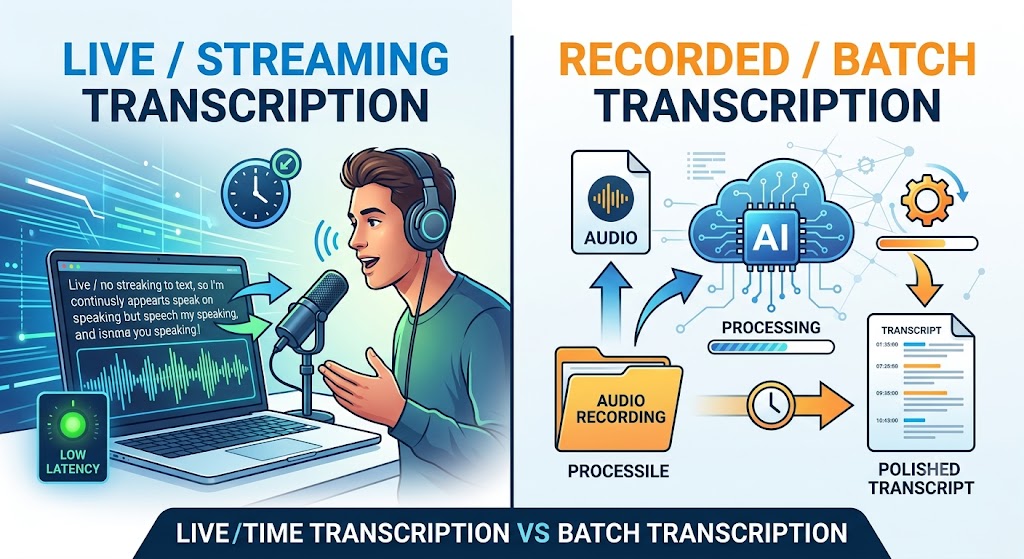
Choose real-time only when a human or system acts on words before the speaker finishes. Live captions, phone-based voice agents, in-meeting assistants and voice control all need streaming, and they pay for it: streaming rates run higher than batch at every provider. If your product can wait until a call, podcast or video is over, batch is cheaper and tends to be more accurate because the model sees the whole recording at once.
A useful rule: batch pre-recorded audio is consistently 30% to 50% cheaper than streaming. Many teams run both, streaming for the live experience and a batch pass afterward for the clean, final transcript. The best APIs support that pattern without forcing you to integrate two vendors.
How we evaluated our Transcription APIs
We compared eight transcription APIs on the dimension that drives this decision: how well each handles real-time streaming versus batch, plus accuracy, price per hour, language coverage and developer experience. Inputs were vendor documentation, current public pricing and third-party benchmark roundups from July 2026.
Benchmarks move and audio varies, so test your shortlist on your own recordings. Where a vendor reports its own leaderboard result, we flag it as self-reported rather than independently verified.
Comparison table
| Rank | API | Best mode | Real-time latency | Batch price (per min) | Best for |
| 1 | Transcribe by Modulate | Both | Sub-second | ~$0.0005 (~$0.03/hr) | Both modes at low cost |
| 2 | Deepgram | Real-time | Sub-100ms | $0.0036 | Voice agents |
| 3 | Gladia | Real-time | Low (streaming) | Usage-based | Startups |
| 4 | AssemblyAI | Batch | Streaming available | $0.0037 | Post-call analysis |
| 5 | OpenAI Whisper / gpt-4o | Batch | Mini streams | $0.003–$0.006 | Cheap batch |
| 6 | Google Cloud Speech-to-Text | Both | Streaming | $0.0048 | Multilingual |
| 7 | Amazon Transcribe | Both | Streaming | $0.024 | AWS stacks |
| 8 | Rev AI | Both | Streaming | $0.02 | Media and captioning |
Disclaimer: Pricing reflects public rates and third-party roundups as of July 2026. Modulate publishes per-hour rates; the per-minute figure is converted. Confirm current pricing with each vendor.
The 8 best Speech Transcription APIs by Mode
1. Transcribe by Modulate: best overall for both modes

- Best mode: both
- Reported WER: 9.35%, and 14.9% on overlapping conversational speech ·
- Price: about $0.03 per hour batch, $0.06 per hour streaming
- Link: Transcribe by Modulate
Transcribe by Modulate leads because it removes the real-time versus batch tradeoff. The same real-time and batch transcription API delivers sub-second streaming for live use and full-file batch for archives, so you integrate once. Modulate reports that it ranks #1 on Hugging Face’s Open ASR Leaderboard with a 9.35% word error rate, and 14.9% on the AMI corpus of overlapping conversational speech, the case where most engines fall apart. Speaker diarization is included at no extra cost, alongside timestamps, PII or PHI redaction and more than 50 languages.
Cost seals it. At roughly $0.03 per hour for batch and $0.06 for streaming, it sits far below the common per-hour rates from the specialists, which matters most exactly when you run both modes at volume.
- Standout features: one API for streaming and batch; free diarization; PII and PHI redaction; 50+ languages; sub-second latency.
- Pros: top conversational accuracy; lowest price per hour here; no need to split modes across vendors.
- Cons: a newer brand with fewer big-cloud integrations than AWS, Google or Azure, and the leaderboard result is self-reported, so verify it on your own audio.
2. Deepgram: best real-time accuracy

- Best mode: real-time
- Reported WER: 5.26% batch, 6.84% streaming
- Price: $0.0036 per minute batch, about $0.0077 streaming
- Link: deepgram.com
Deepgram is the streaming benchmark. Independent roundups report a 5.26% word error rate on batch and 6.84% on streaming, with a sub-100ms latency focus, which is why it powers so many live voice agents. If real-time accuracy is the top requirement and you can accept a streaming premium, it belongs on the shortlist.
- Standout features: sub-100ms streaming; strong accuracy in both modes; clean SDKs; formatting controls.
- Pros: leading real-time performance; competitive accuracy; developer-friendly.
- Cons: streaming pricing is higher than batch, and newer entrants now undercut its per-hour rate.
3. Gladia: best real-time for startups

- Best mode: real-time
- Reported WER: competitive per public leaderboards
- Price: usage-based
- Link: gladia.io
Gladia targets startups that want fast streaming and simple batch without enterprise overhead. Third-party comparisons describe it as a developer-friendly option with real-time and batch support and competitive leaderboard accuracy. Its usage-based pricing and quick setup make it a comfortable first integration for a small team.
- Standout features: real-time and batch; developer-friendly onboarding; usage-based pricing; multiple languages.
- Pros: easy to start; flexible pricing; solid accuracy for the price.
- Cons: less enterprise track record than the incumbents, and rates are not as openly published as some rivals.
4. AssemblyAI: best batch intelligence

- Best mode: batch
- Reported WER: about 14.5% on mixed datasets
- Price: $0.0037 per minute batch
- Link: assemblyai.com
AssemblyAI shines on recorded audio you want to understand, not just transcribe. It layers summarization, topic detection, sentiment and speaker labels onto the transcript, with a batch price near $0.0037 per minute. For post-call analytics, podcast processing or media libraries, it saves you from bolting on a separate analysis pipeline.
- Standout features: audio intelligence models; speaker labels; PII redaction; strong docs.
- Pros: rich post-transcription analysis; good batch pricing; smooth developer experience.
- Cons: reported accuracy on mixed real-world audio trails the leaders, and its streaming story is weaker than the real-time specialists.
5. OpenAI Whisper and gpt-4o-transcribe: cheapest batch via open model

- Best mode: batch
- Reported WER: about 8.9% (gpt-4o-transcribe)
- Price: $0.003 to $0.006 per minute, less via self-hosting
- Link: platform.openai.com
OpenAI’s Whisper family is a batch workhorse, and self-hosting the open model can push cost down further. Roundups put gpt-4o-transcribe near 8.9% WER, gpt-4o-mini-transcribe at $0.003 per minute and Whisper-1 at $0.006, with third-party hosts as low as $0.50 per 1,000 minutes. It is a natural fit for offline processing and teams already on OpenAI.
- Standout features: strong general accuracy; open model option; simple hosted API; broad language coverage.
- Pros: cheap batch; flexible hosted or self-run; good accuracy.
- Cons: real-time support and diarization lag the streaming specialists, so it is not a live-agent engine.
6. Google Cloud Speech-to-Text: best for multilingual, either mode

- Best mode: both
- Reported WER: not published
- Price: $0.0048 per minute (Chirp 2)
- Link: cloud.google.com/speech-to-text
Google Cloud Speech-to-Text supports streaming and batch across a very wide language set. Its Chirp 2 model lists at $0.0048 per minute, falling toward $0.004 at high volume. For multilingual products already on Google Cloud, it covers both modes without leaving the platform.
- Standout features: broad languages; streaming and batch; Google Cloud integration; model options.
- Pros: excellent multilingual coverage; mature and scalable; both modes.
- Cons: no published headline WER, and pricing is above the cheapest specialists at low volume.
7. Amazon Transcribe: best for AWS stacks, either mode

- Best mode: both
- Reported WER: not published
- Price: $0.024 per minute standard
- Link: aws.amazon.com/transcribe
Amazon Transcribe handles streaming and batch inside AWS, with tight ties to S3, Lambda and the rest of the stack. It lists at $0.024 per minute standard, with volume discounts, plus custom vocabulary and redaction. The value is integration, not the lowest rate.
- Standout features: streaming and batch; deep AWS integration; custom vocabulary; redaction.
- Pros: frictionless on AWS; scales well; enterprise features.
- Cons: standard pricing is on the higher end, and it makes sense mainly if you already run on AWS.
8. Rev AI: best for media and captioning
- Best mode: both

- Reported WER: not published
- Price: $0.02 per minute machine, streaming available
- Link: rev.ai
Rev AI comes from a captioning and media heritage, and it offers streaming and batch plus an optional human-transcription path when accuracy has to be near-perfect. Its machine tier lists at $0.02 per minute. For subtitling, media workflows and cases that occasionally need a human in the loop, it is a practical choice.
- Standout features: streaming and batch; captioning-focused tooling; optional human transcription; strong formatting.
- Pros: built for media and subtitles; human option for critical audio; simple API.
- Cons: machine pricing is higher than the cheapest specialists, and raw accuracy figures are less publicized.
How to choose the best Transcription API
Pick the mode first, then the API. If you only need offline transcripts, weigh batch price and accuracy, where AssemblyAI, OpenAI Whisper and Transcribe by Modulate stand out. If you need live text, weigh latency and streaming accuracy, where Deepgram and Gladia lead.
If you need both, an API that does each well from one integration, like Transcribe by Modulate, saves you from stitching two vendors together and is priced to make running both modes affordable.
Then benchmark. Run your real audio through the shortlist in the mode you will actually use, model your monthly minutes split by streaming and batch and confirm current pricing with each vendor before you commit.
Frequently asked questions
1. What is the difference between real-time and batch transcription?
Real-time (streaming) transcription returns text while the person is still speaking, which live captions and voice agents need, and it costs more. Batch transcription processes a finished recording afterward at lower cost and usually higher accuracy because the model sees the whole file. Many APIs support both.
2. Which transcription API is best for real-time?
Deepgram is the real-time benchmark, reporting a 6.84% streaming word error rate with a sub-100ms latency focus. Gladia is a strong developer-friendly option for startups and Transcribe by Modulate delivers sub-second streaming with leading conversational accuracy, so shortlist based on your latency target and audio type.
3. Which transcription API is cheapest for batch?
Transcribe by Modulate lists about $0.03 per hour of batch audio, among the lowest published rates, while most specialists sit between $0.003 and $0.006 per minute and self-hosted Whisper can be cheaper still. Batch is generally 30% to 50% cheaper than streaming across providers.
4. Can one API handle both real-time and batch?
Yes. Transcribe by Modulate, Google Cloud Speech-to-Text, Amazon Transcribe and Rev AI all support streaming and batch. Using a single API for both modes means one integration and one billing relationship, which is simpler than pairing a streaming specialist with a separate batch tool.
5. How accurate are transcription APIs on hard audio?
Accuracy drops sharply on overlapping speakers and noise. On the AMI overlapping-speech corpus Transcribe by Modulate reports a 14.9% word error rate, and general benchmarks show rates climbing well above 50% on the noisiest multi-speaker audio, so always test on recordings that match your real conditions.
Author Profile

- Freelance Journalist & Content Creator
- Content creator and contributor, freelance journalist and writer.
Latest entries
 FinanceAugust 25, 2026Top 6 Accountants & Tax Advisers in Southwest London
 Key ServicesAugust 8, 2026The 8 Best Transcription APIs in 2026: Real-Time vs Batch
 Key ServicesJuly 9, 202612 Leading London Law Firms offering Business Legal Services in 2026
 DictionaryJune 23, 2026Outdoor & Park Yoga in London: Why It’s Booming (and Where to Join)