


Managing business documents keeps getting harder as technology evolves. Businesses now deal with far more files than before, and these files often need to be found quickly and shared easily. Paperwork often piles up, making it tough to keep everything organised. Finding simple and reliable ways to handle these documents is now a must for keeping work running smoothly.
Switching from physical to digital storage solves some problems but adds new ones. Digital documents free up office space. Yet large files use up server capacity and can block emails or uploads. Many businesses run into trouble with document optimisation, especially with PDFs. These files often need to be smaller but must keep their quality.
Practical document storage solutions must balance accessibility, security and day-to-day use. Companies across London and beyond are increasingly seeking streamlined approaches to document management that address these concerns while supporting remote work arrangements and cross-departmental collaboration.
The Document Management Crisis Facing UK Businesses

For many UK organisations, managing digital documents remains a pressing challenge. As teams shift towards electronic file handling, they face increasing pressure to organise growing archives. File naming inconsistencies, scattered storage locations, and poor searchability are now common hurdles for businesses of all sizes.
Businesses often encounter difficulties when attempting to locate information under tight deadlines. Keeping track of updates across multiple versions can be problematic. Collaborating becomes difficult when file sizes make sharing cumbersome.
The need for effective document management is now widely accepted as important for business continuity. UK companies often lose time searching for information, which can impact productivity.
When server storage fills up quickly, business operations can slow considerably. This challenge arises because growing document libraries push servers towards capacity faster than anticipated. Many companies discover that system upgrades become necessary sooner than budgeted.
PDF Optimisation Strategies for Business Efficiency
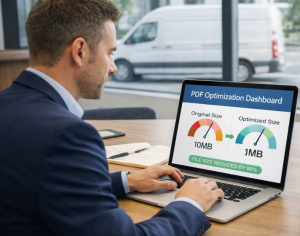
PDF remains the gold standard for business document sharing due to its universal compatibility. However, these files can quickly become difficult to manage, particularly with high-resolution images. Reducing file size supports efficient email distribution and streamlines document management.
Compression methods require a match between document type, intended use, and available tools. In the UK, many business users have access to Adobe Acrobat through site-wide licensing. For text-heavy documents, the “Reduced Size PDF” option provides clear reductions with no loss of clarity.
When handling project packs or brochures with photos, the “Optimise PDF” feature allows control over image quality. Adjusting image resolution helps preserve diagrams while ensuring the final PDF meets size targets.
Different compression levels suit different business scenarios. Light compression works well for client-facing materials where quality matters. Medium compression balances quality and size for internal documents. Tools that compress PDFs to 1MB or lower are especially useful for email sharing.
Integration into document workflows is straightforward. Organisations often implement automated compression during document approval. This approach has proven helpful for financial services firms that regularly share large prospectuses with international clients.
Implementing Secure Document Storage Systems

UK businesses face an important choice between cloud-based and on-premises document storage solutions. Cloud solutions and systems offer flexibility, remote accessibility, and reduced hardware costs. Many organisations now use cloud storage as part of their digital transformation efforts.
On-premises solutions provide greater control over security protocols and compliance measures. These come with higher implementation costs but may be necessary for industries with strict regulatory requirements.
Security considerations must always be the main priority. Document storage systems should include strong encryption and multi-factor authentication. These measures are especially important for businesses handling sensitive client information.
GDPR compliance imposes strict rules because personal data protection is a legal requirement. Failure to comply puts businesses at risk of regulatory fines and reputational harm. Data minimisation limits exposure in the event of a breach.
For practical implementation, businesses can restrict access to only necessary personnel. Audit trails ensure every document access is logged with date and user details, making it easy to trace activity.
Future-Proofing Your Business Document Infrastructure

Modern businesses in the UK are adopting AI-powered document management solutions that can deliver efficiency gains. Intelligent search systems and automated tagging help teams locate files based on content without manual labelling.
Document analytics provide practical business intelligence. Examining access patterns helps businesses determine which documents receive the most attention. These findings are especially useful for marketing materials and training documentation.
Mobile accessibility has become essential for modern workplaces. Efficient document systems must deliver consistent experiences across devices. The ability to access documents from smartphones is now a standard expectation.
Scalability planning helps prevent future bottlenecks. Reviewing monthly document upload patterns and considering anticipated growth can support effective storage capacity planning for your business.
Measuring ROI from Improved Document Management
Efficient document management can deliver measurable returns for businesses. When evaluating outcomes, look at how much faster staff can retrieve documents. Check whether storage bills decrease. Monitor if document approval gets completed in less time.
Time savings are an immediate benefit, though specific figures vary across organisations. Businesses adopting AI-powered document management often report faster productivity and quicker access to information.
While individual savings differ by sector, monitoring time saved provides a reliable way to identify improvements. Track approval speeds and IT support tickets to measure real progress.
Author Profile

- Blogger by Passion | Contributor to many Business Blogs in the United Kingdom | Fascinated to Write Blogs in Business & Startup Niches
Latest entries
 Business AdviceOctober 1, 2026Less Chasing, More Selling: Rethinking the Estate Agency Workflow
 Business AdviceSeptember 15, 2026When & Why UK Entrepreneurs Would Need To Think About Document Legalisation
 FinanceSeptember 3, 2026Why Online Donation Platforms Are the Future of Digital Fundraising
 Business AdviceJune 9, 2026The Complete Guide to Choosing a Paper Shredder for Your Office