

Norwich has been crowned the UK’s best place to be single in 2026, ahead of bigger hitters like London, Liverpool and Glasgow, in a new data-led index that spotlights where single adults can enjoy the best blend of opportunity, lifestyle and affordability.
Commissioned by adult services platform AdultWork, the study ranks 346 local authorities across England, Scotland and Wales on five key factors for single people: the size of the local dating pool, the affordability of renting a one-bedroom home on the median salary, the density of dining and daytime venues, the strength of nightlife, and overall safety.
Each area was given a weighted ‘freedom index’ score out of 100, building a picture of where single life is most sustainable – and where cost pressures risk eroding quality of life.
Norwich leads a reshaped Single-Life Map
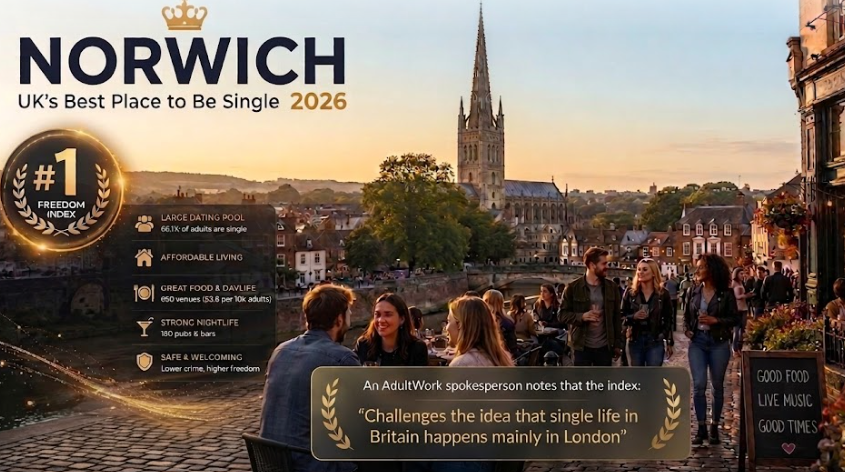
Norwich tops the national list with a freedom index score of 63.78 – positioning the Norfolk city as the standout destination for single adults in 2026. ONS data shows that 65.1% of Norwich’s adult population is legally single, equivalent to 78,635 people, giving it one of the largest dating pools in the UK relative to population.
The city also offers strong social infrastructure: 650 dining and daytime venues (53.8 per 10,000 adults) and 160 pubs and bars, providing multiple touchpoints for informal networking, socialising and dating.
On affordability, a typical one-bedroom home costs £9,360 per year, representing 30.5% of the local median wage of £30,716 – a mid-table result, but significantly below the rent-to-income ratios seen in many parts of London and the South East.
London Boroughs still Competitive – but not Dominant
The findings will be of particular interest to London-based employers and investors watching migration trends among younger workers and single professionals. While London no longer defines the top of the table, two of its boroughs – Camden and Islington – still feature in the national top 10.
Camden ranks seventh overall with a freedom index score of 59.36, and Islington follows closely in eighth on 58.90, reflecting their combination of large single populations, dense hospitality sectors and strong nightlife. These boroughs continue to offer the kind of urban ecosystem that attracts high-earning, mobile professionals – but the wider index indicates that the capital’s premium is becoming harder to justify for many single renters.
At the other end of the spectrum, London and the South East dominate the bottom of the ranking. Harrow is identified as the worst place in the UK to be single in 2026, with Redbridge and Hart also in the bottom three. In Harrow, a typical one-bed rent of £16,500 a year consumes 43.9% of the local median salary, illustrating how quickly housing costs can undermine the freedoms that single adults seek.
Regional Winners: Opportunity beyond the Capital
Elsewhere in the country, the index highlights a range of alternative hubs for single professionals. Liverpool places second with a score of 62.39, home to 254,020 single adults – 63% of its population – and a relatively favourable cost profile, with a one-bed at £8,064 taking 25.6% of the local median wage of £31,476.
Powys in mid Wales takes third place, driven by highly affordable housing and a strong hospitality offering. One-bedroom rents there average £5,556 per year – just 17.9% of typical local earnings – and the county has the second highest ratio of pubs and bars per head of any local authority in the study, alongside a strong showing for restaurants and cafés. Dundee (fourth) and Glasgow (ninth) lead the Scottish contingent, while Lincoln, Gwynedd and Blaenau Gwent complete the top 10.
Across the top-performing areas, a clear pattern emerges: locations that combine a substantial single population with realistic housing costs and a rich ecosystem of cafés, restaurants and nightlife tend to outrank more expensive metropolitan centres, even when those cities offer larger absolute dating pools.
How the Freedom Index works
AdultWork’s index is built on five metrics, each scored out of 10 and combined into a final weighted score out of 100. The dating pool – the proportion of adults aged 18 or over who are legally single, as defined by ONS (never married and never in a civil partnership) – carries the highest weighting at 30%.
Affordability (20%) is measured by the share of the local median annual wage required to rent a one-bedroom property for a year, with lower percentages scoring higher. Dining and daytime venues (15%) consider the number of restaurants, cafés, takeaways and hotels per 10,000 adults, while nightlife (20%) looks at pubs, bars and nightclubs on the same per-capita basis. Safety accounts for the remaining 15%, based on recorded crimes per 1,000 people, with lower crime rates improving the score.
Data sources include ONS Census 2021 marital and partnership status, the ONS Annual Survey of Hours and Earnings, ONS regional rental price statistics, the Food Standards Agency establishment register, and Police.uk crime data. Scores were standardised using min–max normalisation, and Northern Ireland was excluded because consistent data at the same geographic level was not available.
Implications for London’s Business Community
Commenting on the research, an AdultWork spokesperson notes that the index:
“challenges the idea that single life in Britain happens mainly in London”
Highlighting that smaller cities such as Norwich, Liverpool, Lincoln and Dundee, and rural Welsh areas like Powys and Gwynedd, are as competitive alternatives for single adults.
For London-focused employers, property developers and policymakers, the findings will add to the conversation about retention and attraction of younger, single workers. As housing costs remain high across much of the capital and its commuter belt, the freedom index suggests that many single professionals could achieve a better balance of disposable income and lifestyle by looking beyond the South East – even if central London boroughs like Camden and Islington continue to perform well for those who can afford them.
-ends-
Author Profile

- Always on the chase after hot and trending London and UK business news that disrupt, inform and inspire.
Latest entries
 Business Innovation NewsOctober 1, 2026Morus Art Group launches in London with Out Of The Blue Exhibition
 Business SpotlightSeptember 29, 20267 Things you might not realise your Limited Company can pay for
 Business SpotlightSeptember 29, 2026How a New Relevant Life Insurance Website Supports UK Limited Company Directors
 Business Innovation NewsAugust 28, 2026IFB brings the Search for regulated financial Companies to Mobile