

The term ‘bleisure’ is a portmanteau of business and leisure.
Bleisure travel refers to the practice of business travellers adding leisure time to a trip, usually by extending a stay before or after their work commitments.
The Cambridge Dictionary defines bleisure travel as ”the activity of combining business travel with leisure time.” (Cambridge Dictionary)
Business travel platform Navan defines it more precisely as: “a blend of business and leisure activities during a work trip.” (Navan)
The Growth of Bleisure Travel in London and the UK
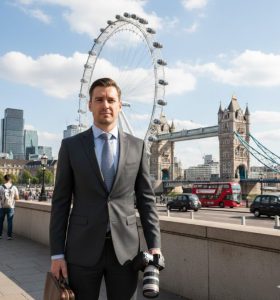
Bleisure travel has moved from being a quirky perk to a mainstream part of UK business culture, especially in London.
London is regarded as the 2nd most popular city in the world for bleisure travel, thanks to its massive conference industry, cultural attractions, and international connections. (Cark Friedrik)
According to Grand View Research, the UK bleisure market was worth $86.1 billion in 2022, and it’s
expected to nearly triple to $235.6 billion by 2030; that’s a staggering 13.4% annual growth rate (Grand View Research).
Globally, the trend is just as strong. SAP Concur, one of the world’s leading business travel management platforms, reports that the global bleisure travel market reached £515 billion in 2024, and is expected to keep expanding rapidly for the next decade (SAP Concur).
Also Read: London’s Hospitality Industry: Embracing New Trends
Customer Perceptions Around Bleisure Travel

UK professionals genuinely like bleisure travel.
According to a recent SAP Concur survey, 78% of UK business travellers believe that bleisure improves their work trip experience, while 55% say it directly helps their work–life balance (Cavendish Conferences).
No wonder 73% of UK employees now see bleisure as a key job perk, and 22% would even refuse a work trip if they couldn’t add personal time (American Express GBT). Almost half of all travellers (48%) say they are likely to extend a business trip if the city has appealing attractions or entertainment. (Expedia)
What Bleisure Travel Means for Employers

For SMEs, the rise of bleisure introduces complex legal and insurance obligations.
“Duty of Care”, which is the moral and legal responsibility to protect an employee’s well-being, is codified in the UK through the Corporate Manslaughter Act 2007. (UKSTAA)
One of the biggest risks for UK firms is the “insurance gap.” Standard business policies may fail if an employee falls ill during a leisure extension or if work laptops are lost while the traveller is “off duty.” (Voyager Protect)
Finally, it is worth noting that official data on bleisure is inferred. The Office for National Statistics (ONS) manages the International Passenger Survey (IPS), but because it typically records only the “main reason” for a visit, it can miss the nuance of a blended trip. (ONS)
If you have new UK data, workplace travel insights, or research exploring how bleisure travel is reshaping business culture, please write to us.
Disclaimer: All the information provided was correct at the time of publication (January 2026) and was collected with the help of accredited
Author Profile

- Always on the chase after hot and trending London and UK business news that disrupt, inform and inspire.
Latest entries
 CryptocurrencyMarch 16, 2026The Rise & Fall of Cryptocurrency: What’s Happening with Digital Money in 2026
 DictionaryMarch 2, 2026How much does a London Gym Membership Cost?
 DictionaryFebruary 4, 2026What Is Bleisure Travel?
 Business Innovation NewsJanuary 26, 2026Marylebone Diagnostic Centre Launches the UK’s First Immediate At-Home Semen Analysis Concierge Service