

Cryptocurrency has come a long way since the early boom years when Bitcoin and other digital assets captured the public imagination, but there have been extreme market movements.
What started as a niche experiment in digital money has grown into a global financial market worth trillions of pounds at times.
For UK investors and everyday users, the big question today is not just whether crypto will keep growing or crashing — but whether it could eventually become a mainstream payment method in Britain.
With many concerned about their investments, our brief overview of how the market evolved and where things stand now can give an indication of how cryptocurrencies will evolve in 2026.
From Speculation to Global Industry
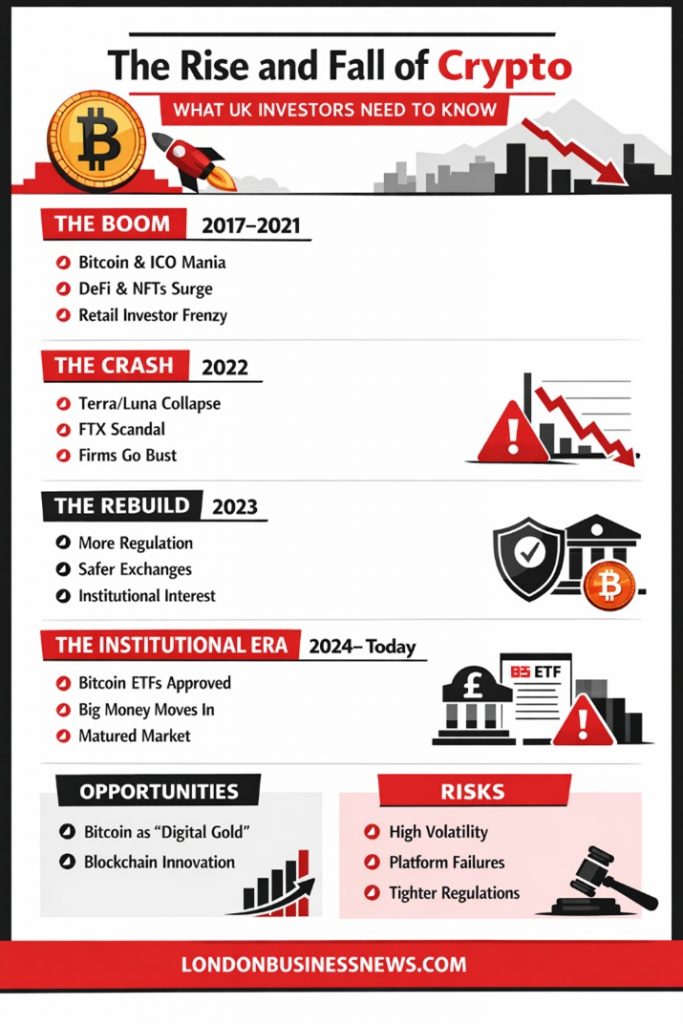
The cryptocurrency boom began to gather momentum between 2017 and 2021. During this period:
- Bitcoin and other cryptocurrencies surged in price
- Millions of retail investors entered the market
- New sectors such as decentralised finance (DeFi) and NFTs emerged
Low interest rates and pandemic stimulus money helped fuel the surge as investors searched for higher-risk opportunities.
However, the boom also exposed weaknesses in the sector. In 2022, the market experienced a severe downturn after several major crypto companies collapsed, including the exchange FTX and lender Celsius. These failures highlighted the risks of poor oversight, excessive borrowing and weak consumer protections.
The crash forced the industry to mature and we offered crypto market analyses during this tumultuous period.
Crypto’s Rebuild Phase

From 2023 onwards, the crypto sector began rebuilding credibility. Companies introduced stronger transparency measures and regulators started drafting clearer rules for digital assets.
Institutional investors also began taking the market more seriously. The approval of Bitcoin investment funds in traditional markets helped bring large financial firms into the space.
As a result, the industry has shifted from a largely speculative retail market toward one increasingly shaped by institutions, regulation and financial infrastructure.
The UK’s Approach to Crypto
The United Kingdom is currently creating a comprehensive regulatory framework for digital assets.
New legislation is expected to bring cryptocurrency companies under financial regulation similar to other investment services, with rules due to take effect from October 2027.
The goal is to protect consumers while still allowing the sector to grow. The government says clearer rules should boost confidence and help prevent fraud and misconduct in the market.
Today, crypto businesses operating in the UK must also register with the Financial Conduct Authority (FCA) under anti-money-laundering rules before providing services.
At the same time, regulators regularly warn that cryptocurrency investments remain high risk and largely unregulated compared with traditional financial products.
Could Crypto Become a Payment Method in the UK?
This is one of the most frequently asked questions about the future of digital assets.
At present, cryptocurrencies such as Bitcoin are not legal tender in the UK, and there are no plans to make them official national currencies.
However, there are three developments worth watching.
1. Stablecoins for Payments
Regulators believe stablecoins — digital currencies linked to traditional currencies like the pound or dollar — could potentially be used for payments if properly regulated.
The Bank of England has said that widely used stablecoins would need to meet standards like traditional forms of money before they could be used in the UK economy.
The Financial Conduct Authority has also signalled that stablecoin payments are a priority area for experimentation, including through regulatory sandboxes for fintech firms.
2. Central Bank Digital Currency (Digital Pound)
The UK is also exploring a central bank digital currency, often referred to as a “digital pound”.
This would not be a cryptocurrency like Bitcoin but a digital version of the pound issued by the Bank of England.
3. Continued Debate on Crypto Payments
Some policymakers and businesses support broader adoption of crypto payments, while others remain cautious.
Recent discussions among regulators highlight concerns that poorly regulated digital currencies could threaten financial stability or monetary sovereignty if they became widely used.
For now, cryptocurrencies are mostly used as investment assets rather than everyday payment tools.
Crypto Opportunities in the UK
Despite volatility, cryptocurrencies still present several potential opportunities.
Portfolio diversification
Some investors view assets like Bitcoin as a long-term speculative investment like digital gold.
Financial innovation
Blockchain technology continues to develop applications in finance, payments and digital ownership.
Institutional adoption
Large financial firms and investment platforms are increasingly offering crypto-related products, which could make the market more accessible and regulated over time.
Crypto Risks in the UK
Crypto still carries significant risks, especially for casual investors.
Price volatility
Cryptocurrencies can experience dramatic price swings.
Platform failures
Past exchange collapses have shown that where you store your crypto matters as much as what you buy.
Regulatory changes
As the UK introduces new rules, some services or business models may change.
Scams and hype
Fraud and misleading projects remain common in the sector.
Cryptocurrencies Remain Volatile

Cryptocurrency is no longer just a speculative internet trend. It is evolving into a regulated financial industry with growing institutional involvement.
However, in the UK it is still primarily treated as an investment asset rather than an official payment system.
While technologies such as stablecoins and digital currencies may eventually influence how payments work, widespread everyday use of cryptocurrencies for purchases in Britain remains uncertain.
For investors and users, the key is to stay informed, approach the market cautiously, and recognise that while crypto has matured, it is still one of the most volatile areas of modern finance – so stay updated!
Author Profile

- Always on the chase after hot and trending London and UK business news that disrupt, inform and inspire.
Latest entries
 CryptocurrencyMarch 16, 2026The Rise & Fall of Cryptocurrency: What’s Happening with Digital Money in 2026
 DictionaryMarch 2, 2026How much does a London Gym Membership Cost?
 DictionaryFebruary 4, 2026What Is Bleisure Travel?
 Business Innovation NewsJanuary 26, 2026Marylebone Diagnostic Centre Launches the UK’s First Immediate At-Home Semen Analysis Concierge Service